Research
Cavity quantum materials
Can an electromagnetic environment change what a material is?
Materials are usually chosen for their intrinsic properties. We explore the reverse: an environment that activates behavior the material cannot show on its own. Nanogap cavities have already turned slow materials into ultrafast photodetectors and produced nonlinear responses absent from the bulk.
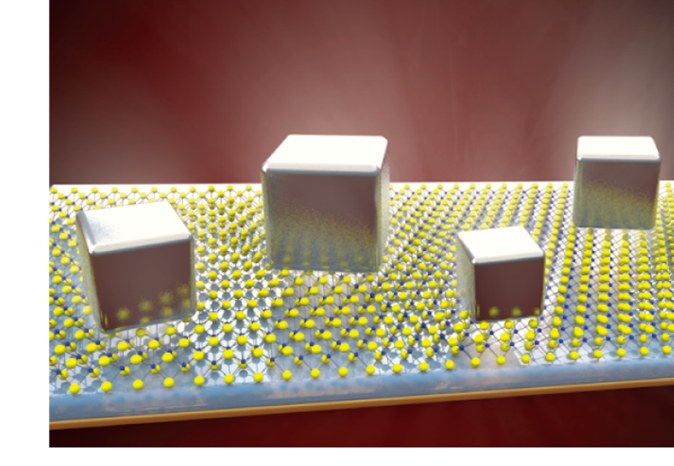
Our next step is to embed two-dimensional magnets and other correlated van der Waals materials in nanogaps — where vacuum fluctuations are strongest — and test whether a cavity can shift magnetic order and correlated phases. Theory predicts it can; the experiments at optical frequencies are only beginning.
Key papers
- Tailored emission spectrum of 2D semiconductors using plasmonic nanocavities
J. Huang, G. M. Akselrod, T. Ming, J. Kong, M. H. Mikkelsen, ACS Photonics 5, 552–558 (2018) · DOI — ACS Editors' Choice - Leveraging nanocavity harmonics for control of optical processes in 2D semiconductors
G. M. Akselrod, T. Ming, C. Argyropoulos, T. B. Hoang, Y. Lin, X. Ling, D. R. Smith, J. Kong, M. H. Mikkelsen, Nano Letters 15, 3578–3584 (2015) - Ultrafast pyroelectric photodetection with on-chip spectral filters
J. W. Stewart, J. H. Vella, W. Li, S. Fan, M. H. Mikkelsen, Nature Materials 19, 158–162 (2020) · DOI - Uncovering the mechanisms of triplet-triplet annihilation upconversion enhancement via plasmonic nanocavity tuning
R. E. Bangle, H. Li, M. H. Mikkelsen, ACS Nano 17, 24022–24032 (2023)
The other questions
- Atomic-scale nanophotonics — How small can an optical cavity become — and what changes when it does?
- Quantum light–matter interactions — What can a single emitter do when the vacuum around it is engineered?
- Nonlinear and ultrafast photonics — What happens to light and matter on femtosecond timescales in an extreme field?